From Technical Specification to Print-Ready Pack: Managing Artwork for Oils & Lubricants
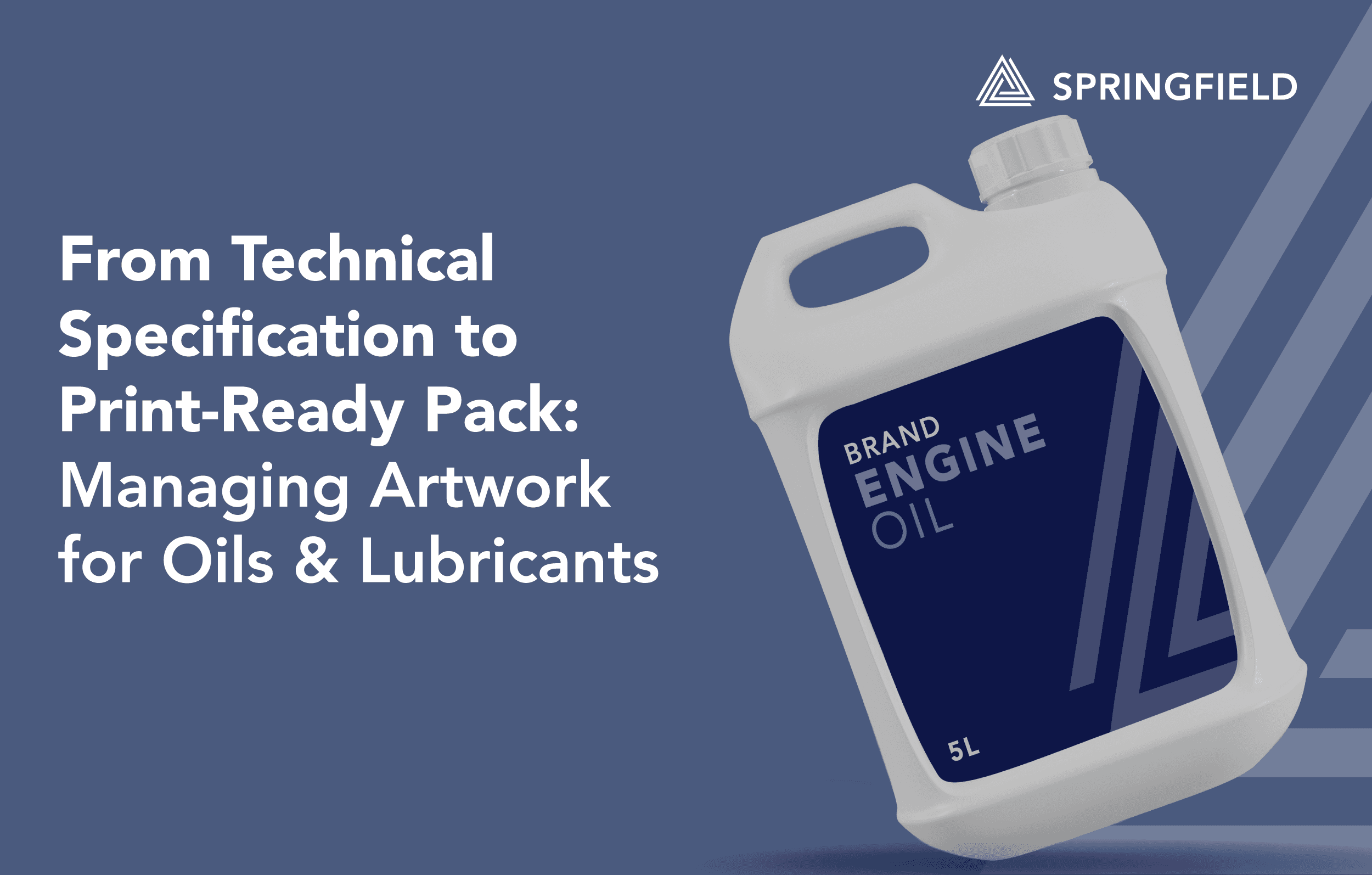
Packaging artwork for oils & lubricants is never as simple as placing the brand, product name and barcode onto a label.
Behind every product, be that in a can, bottle, drum, pouch or carton, is a technical artwork process that must balance brand consistency, print performance, production requirements and regulatory accuracy.
For industrial, automotive and chemical products, that process is complex. One missed hazard statement, incorrect colour breakdown, outdated specification or mismatched SKU detail can create costly delays, reprints, compliance risks and pressure on internal teams.
In this blog, we will explore why industrial packaging artwork requires a more specialist approach than conventional FMCG packaging, and how to implement a smoother artwork process.
Why oils and lubricants packaging artwork is so technically demanding
Oils and lubricants brands often have extensive product ranges, with multiple pack sizes, markets, language requirements and technical claims to manage.
Each variation must be consistent, meet exacting print requirements and carry the correct usage, safety and regulatory information.
This is why industrial packaging artwork including those for oils and lubriants brands carries a different level of responsibility.
Where consumer product packaging, such as food and drink, usually focuses on shelf appeal – oils, lubricants and related chemical products favour communication of precise product performance and handling information. All whilst, of course, still looking good on shelf!
Technical specifications of products need to be positioned clearly on pack without compromising the design, including information such as:
- Viscosity grade
- Application area
- Safety guidance
- Storage instructions
- Batch coding
Oils and lubricant packaging artwork also often needs to adapt to very different packaging formats and sizes. From small labels on bottles to large industrial drums.
Each format brings its own considerations when it comes to label artwork inlcuding:
- Cutter guides
- Label construction such as peel and read, booklet labels and wraps
- Print tolerances
- Barcode positioning
- Ink coverage
- Varnish areas
- Material performance
A design that works technically on one pack size may need careful adaptation to remain legible and compliant on another.
Technical artwork consultancy – and why the experts should be involved from the start
The earlier technical artwork expertise is brought into a packaging project, the easier it is to prevent problems later.
Springfield supports brands with technical artwork consultancy, helping teams interpret print specifications, understand packaging constraints and turn approved creative concepts into viable production artwork.
We remove the risk and ensure the right results the first time around. Including comprehensive support with:
- Cutter guides
- Information hierarchy
- Mandatory content areas
- Identification of anything that may cause print issues or delays in the production process
Rather than treating artwork as the final administrative step, it should be approached as a controlled technical process.
This helps your brand, regulatory, marketing and production stakeholders align before files reach the printer. For oils and lubricants businesses working to tight launch dates, that level of upfront clarity is invaluable. Benefits include reduction of amendment loops and the confidence that every file is being built with print production in mind.
Artwork adaptation across multiple SKUs
A key element of artwork management for oils and lubricants brands is adapting artworks across multiple SKUs and packaging types.
Many lubricant ranges include multiple SKUs that may look similar but differ in critical details.
A product family might include different viscosity grades, application types, performance standards, capacities, languages and regional pack requirements. At scale, this creates a high risk of version confusion, particularly when updates are happening quickly or across several markets at once.
Springfield helps simplify this by adapting master artwork across SKUs in a structured, consistent way.
The team roll out approved design systems across different pack formats and product variants while protecting brand consistency and checking that the right content appears in the right place.
For industrial packaging, this matters as the smallest content variation can affect compliance, production, and even customer usability.
Applying and updating regulatory information
Another reason why artwork management can be complex for brands in the oils and lubricants sector is regulation.
Regulatory content is one of the biggest pressure points in chemical packaging artwork, as this is often changing and developing. Labels and packaging must house key regulatory information, including:
- Hazard pictograms
- Signal words
- Precautionary statements
- Product identifiers
- Supplier information
- Health and safety information
- Usage and disposal information
In the UK, the Health and Safety Executive oversees chemical classification, labelling and packaging requirements, including GB CLP duties for suppliers placing chemicals on the market. This makes accuracy, traceability and timely updates a requirement for brands managing oils, lubricants and related chemical products.
Springfield supports the practical application of approved regulatory information into artwork, helping ensure supplied content is placed clearly, consistently and in line with pack constraints.
When legislation, market guidance or product formulations change, controlled artwork updates are vital. Without a robust process, teams can end up with outdated PDFs, conflicting approvals and uncertainty over which file is production ready.
Colour management for consistency across substrates
Colour consistency is also a key consideration in oils and lubricants packaging artwork.
This can be difficult to maintain when artwork is printed across different materials, suppliers and technologies. But it’s so important for brand integrity.
Oils and lubricants packaging must consider multiple applications including labels, cartons, flexible packaging or metal drums. A brand colour that appears strong on a coated label stock may reproduce differently on another material or across different print processes.
Springfield’s colour management expertise helps reduce this uncertainty.
By working with colour targets, printer specifications and production variables, the team help brands maintain visual consistency across SKUs, markets and packaging types. This is especially important for ranges where colour helps customers quickly distinguish between product grades, applications or performance levels.
Managing artwork versions through a DAM system
You have considered the technical details of your packaging artwork, all regulatory information is up to date, and colour performance is consistent across SKUs and packaging types. But what about managing all these files ready for when the next round of changes or recalls happen?
This is where asset management through a DAM system comes in.
Packaging artwork management controls the creation, review, approval and storage of product packaging assets. As product ranges expand and markets swell, a strong asset management system becomes a definitive advantage for brands.
At Springfield, our DAM system allows customers to keep on top of:
- Which artwork is current
- Which files have been approved
- What has changed
- Who signed it off
- Where each asset is being used
This is particularly important for technical packaging artwork, where version errors can lead to the wrong specification, outdated regulatory copy or incorrect SKU information reaching production.
Brands managing industrial packaging artwork across multiple regions can benefit from a higher level of control and trust.
Springfield as an extension of your packaging team
For oils and lubricants brands, your packaging artwork is a technical and regulatory asset which must be treat and managed carefully.
At Springfield, our teams are experienced in acting as an extension of your packaging team, supporting projects from design adaptation and technical artwork through to reprographics, colour management, pre-press and production-ready files.
Our services are designed to remove complexity, protect accuracy and give every stakeholder greater confidence at each stage of the process.
Whether you are launching a new lubricant range, updating regulatory information, rolling out artwork across multiple SKUs or trying to bring more control to global packaging files, Springfield provides the technical packaging artwork support needed to keep projects moving.
Partner with Springfield and have confidence in your packaging.